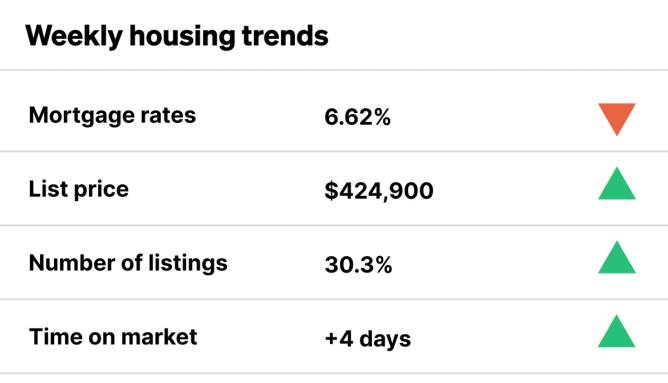
THE NUMBERS - Mortgage rates dropped again this week to 6.62% for a 30-year fixed-rate home loan, marking their 12th week under the dreaded 7% threshold. Purchase applications are climbing as hopeful homebuyers scramble to take advantage of this rate break while it lasts. However…
- Listing prices inched up by 0.1% compared to this same week last year. That’s not much of a bump, but it’s worrisome since it’s the first year-over-year increase after 44 weeks of flat or falling prices. The asking price of the typical home currently hovers at $424,900.
- The number of homes for sale ballooned for the 74th straight week, with 30.3% more properties to pick from than a year ago. Plus, fresh new listings are up by 8.6%, just in time for the spring rush.
- Homes lingered on the market four more days compared to this week last year. The pace of sales has been slowing down for nearly a year as shoppers take their time finding the best deal.
|
|
|
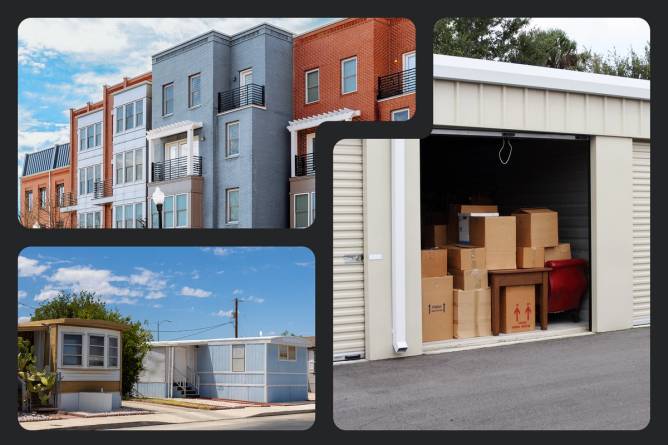
THE BIG STORY With President Trump's whiplash-inducing tariff announcements sowing chaos for global trade, what damage will the levies do to the housing market—which was already on life support? Some warn that we should brace for even higher home prices, while others pray that mortgage rates will plunge. Meanwhile, house flippers, landlords, and other real estate investors are scrambling to overhaul their strategies before they’re stuck paying for “made in China” merchandise that’s doubled in price overnight. “My immediate worry is the renovation budget,” says Max Cohen of FLHomeBuyers.com. “Kitchens highlight the issue; lots of the affordable cabinet lines are imported from China.” With tariffs for this country currently at 145%, “the materials cost for a kitchen job could easily spike.” Tariffs are also changing where investors shop for supplies. “We recently had a quote from Home Depot on windows that came in around $50K,” recalls Ryan Dossey at SoldFast.com.“The same materials at a local window supply were $37K. We buy most of our paint and flooring from Sherwin-Williams, an American company headquartered in Ohio.” As for rentals, tariffs have convinced Cohen to work harder on maintaining systems in his 40 properties to make them last, by “adding things like surge protectors and just plain doing more hands-on work myself.” He also admits that he might be forced to raise rents higher than his annual max increase of 3%. If tenants start moving or stop paying, it may make more sense to sell. Although worries are rippling throughout the housing market, Brian Davis, who runs a real estate investment club that hosted a workshop this week about tariffs, says he also spots opportunities. “The two big risks from tariffs are inflation and recession,” Davis explains. “From there, you can frame the problem in more familiar terms: Which investments protect against both inflation and recessions?” Inflation is the easy one. “Real estate has a long history of outperforming inflation,” he says. However, “Recessions are a harder nut to crack. Many real estate investments, such as office buildings, do poorly in recessions.” Yet, certain types tend to fare well during economic downturns. Here are a few that real estate investors are eyeing right now. Multi-family affordable housing Cheap rent never goes out of style, which is why government-subsidized affordable housing tends to boast years-long waiting lists and 100% occupancy. Though these investments might take a minor hit on revenue by offering way-below-market rents, they more than make up for it with property tax savings. Mobile home parks with tenant-owned homes Although some mobile home parks rent out homes, many simply rent out the land beneath to mobile homeowners. These parks are recession-friendly bets, according to Davis: “It costs an average of $6,500 to move a single-wide home and $11,500 to move a double-wide. If you have a choice between renting a [$500-per-month lot] or paying $6,500 to move your home, which will you pay? Even when feeling pinched, or especially when feeling pinched, mobile home owners will stay put.” Storage facilities During the housing crash of 2008, self-storage was the only real estate asset class that rose in value. Why? Because even if a recession forces you to downsize, you still want to keep all your stuff. Abandoned half-built projects Since tariffs may force less-capitalized developers to bail on specific projects, this presents a bargain-basement buying opportunity. “We’ve bought three stalled building projects from other investors who couldn’t take on higher material costs, acquiring these properties at discounted prices,” says Erik Wright, founder of New Horizon Home Buyers. Pre-existing properties Because tariffs are predicted to jack up the cost of brand-new homes by $9,200, this could be a good thing for homes that squeaked into existence before those pricey lumber levies, driving up demand. Light fixer-uppers Massive fixer-uppers may make for entertaining reality TV, but when money is tight, they’re a turnoff for homebuyers and investors alike. Cohen, for one, is “leaning toward lighter rehabs versus full guts.” | | |
|
|
QUICK LINKS  Spring’s hottest market is in a chilly place. Zillow released its best markets for buyers and sellers this season, and the top place for sellers has maintained its lead: Buffalo, NY. Lake-effect snow is no match for this red-hot market, in which real estate sells in a mere 12 days, with bidding wars that drive up over half of listings to above asking price. Meanwhile, beach lovers will be happy to hear that the best market for buyers is Miami. Here, home shoppers can take their sweet time since houses linger on the market for 60 days and nearly a quarter undergo price cuts. Spring’s hottest market is in a chilly place. Zillow released its best markets for buyers and sellers this season, and the top place for sellers has maintained its lead: Buffalo, NY. Lake-effect snow is no match for this red-hot market, in which real estate sells in a mere 12 days, with bidding wars that drive up over half of listings to above asking price. Meanwhile, beach lovers will be happy to hear that the best market for buyers is Miami. Here, home shoppers can take their sweet time since houses linger on the market for 60 days and nearly a quarter undergo price cuts.
 Stock volatility may be scaring off homebuyers. Although Redfin found that one in five homebuyers had at least planned to sell equities to fund a down payment back in September 2024, Wall Street’s recent plunge may convince these buyers to slam on the brakes. As Redfin economics research lead Chen Zhao points out, “Big drops in the stock market not only cut into funds earmarked for down payments and other housing costs, they shake consumer confidence and make people feel poorer.” However, she adds, “a volatile stock market can encourage people to invest their money in real estate instead of stocks because some may view a home as a safer investment.” Stock volatility may be scaring off homebuyers. Although Redfin found that one in five homebuyers had at least planned to sell equities to fund a down payment back in September 2024, Wall Street’s recent plunge may convince these buyers to slam on the brakes. As Redfin economics research lead Chen Zhao points out, “Big drops in the stock market not only cut into funds earmarked for down payments and other housing costs, they shake consumer confidence and make people feel poorer.” However, she adds, “a volatile stock market can encourage people to invest their money in real estate instead of stocks because some may view a home as a safer investment.”
 Mortgage rates may be at the mercy of foreign investors. China, Japan, Taiwan, and Canada are among the countries that own $1.32 trillion worth (15%) of US mortgage-backed securities (MBS), according to the Government National Mortgage Association, aka Ginnie Mae. China and Japan started unloading some of these holdings last year, which has some experts worried that Trump’s latest trade policies could convince them to dump more. The upshot? This could push up mortgage rates and crush the already delicate housing market right as it’s trying to muster up some spring fever. Mortgage rates may be at the mercy of foreign investors. China, Japan, Taiwan, and Canada are among the countries that own $1.32 trillion worth (15%) of US mortgage-backed securities (MBS), according to the Government National Mortgage Association, aka Ginnie Mae. China and Japan started unloading some of these holdings last year, which has some experts worried that Trump’s latest trade policies could convince them to dump more. The upshot? This could push up mortgage rates and crush the already delicate housing market right as it’s trying to muster up some spring fever.
 Home equity is flying high. Home equity has risen nearly 80% since early 2020 to almost $35 trillion, according to the Federal Reserve. That’s about double the increase in overall wealth from all sources, including stocks and bonds, through the end of 2024. Plus, tapping into this equity has gotten more enticing since the average rates on home equity lines of credit are at their lowest level in two years. Home equity is flying high. Home equity has risen nearly 80% since early 2020 to almost $35 trillion, according to the Federal Reserve. That’s about double the increase in overall wealth from all sources, including stocks and bonds, through the end of 2024. Plus, tapping into this equity has gotten more enticing since the average rates on home equity lines of credit are at their lowest level in two years.
 Home insurance rate hikes are ahead. In 2025, homeowners across the US will have to cough up an extra $261 more on property insurance premiums, an 8% rise from the previous year to a national average of $3,520. Although wildfire-ravaged California will suffer the most significant annual increase of 21% to $2,930 on average, hurricane-prone Floridians will still pay the most at $15,460. Home insurance rate hikes are ahead. In 2025, homeowners across the US will have to cough up an extra $261 more on property insurance premiums, an 8% rise from the previous year to a national average of $3,520. Although wildfire-ravaged California will suffer the most significant annual increase of 21% to $2,930 on average, hurricane-prone Floridians will still pay the most at $15,460.
 Bigger bedrooms bring joy. According to the National Association of Realtors and National Association of the Remodeling Industry’s 2025 Remodeling Impact Report, three home improvement projects received a perfect “joy score” of 10: a new roof, a kitchen reno, and upgrading from a regular old bedroom to a bells-and-whistles primary bedroom suite. Because after all that hard work renovating a house, nothing beats a good night’s sleep. Bigger bedrooms bring joy. According to the National Association of Realtors and National Association of the Remodeling Industry’s 2025 Remodeling Impact Report, three home improvement projects received a perfect “joy score” of 10: a new roof, a kitchen reno, and upgrading from a regular old bedroom to a bells-and-whistles primary bedroom suite. Because after all that hard work renovating a house, nothing beats a good night’s sleep.
|
|
|
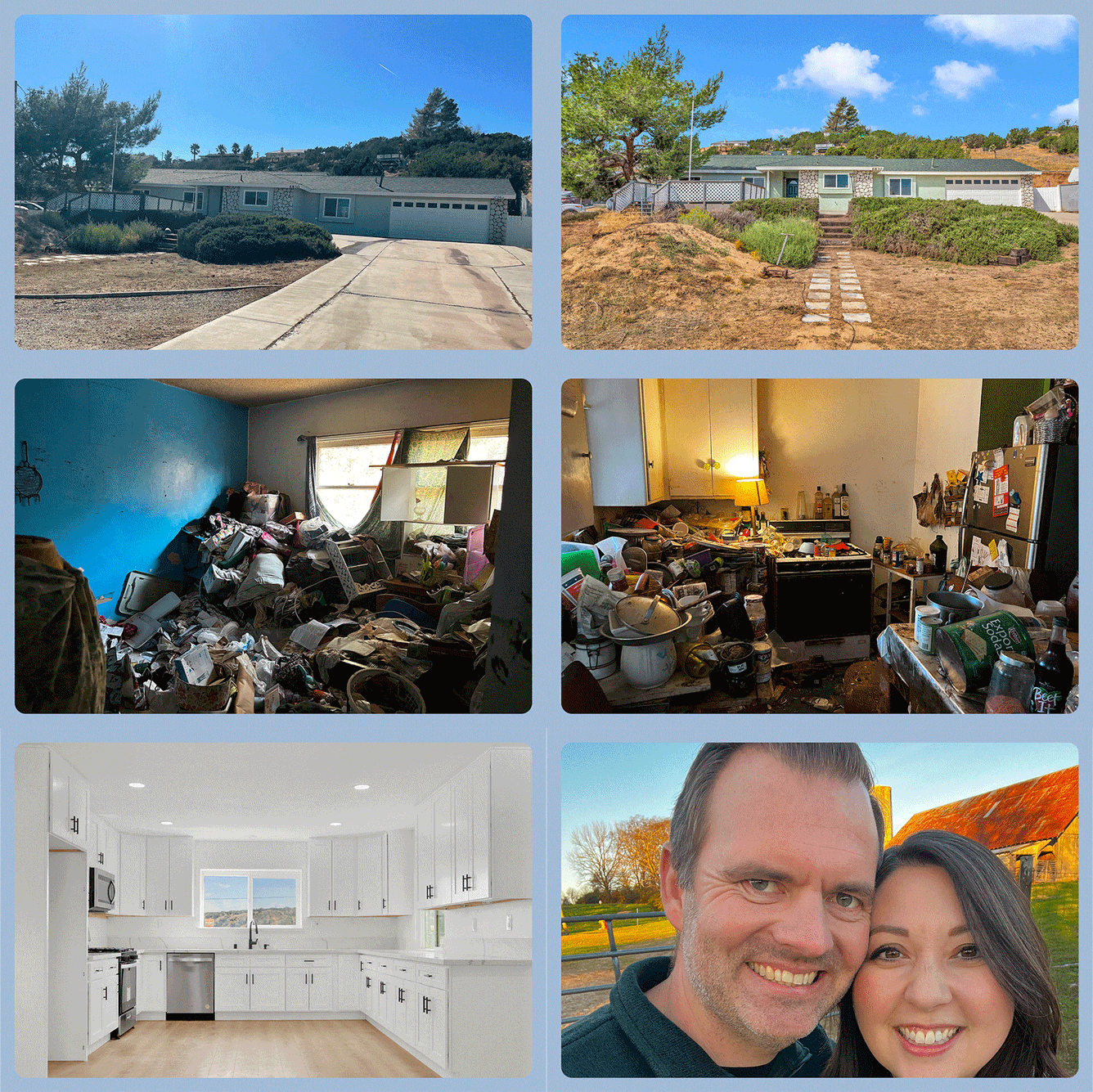
REAL TALK Husband-and-wife real estate investors Casey and Jillian TeVault in Diamond Bar, CA, often tackle the unappetizing task of purging houses packed with, well … everything. Hoarder homes may be bargains, but what does it really take to wipe a slate like that clean? Casey recounts one of their most challenging recent projects, which he nicknamed the High Desert Hoarder House, and all the teachable moments within. How’d you end up with this eyesore of a property? “The owner of the property found me online and reached out for a cash offer. Her property was infested by rats, she had just gotten divorced, and she was in the process of moving from California to Arizona for a fresh start. She knew that she didn’t have the time, money, or bandwidth to clean up, fix, and list the property. My wife was actually really excited about the project, so we bought it for $285,000, and the seller was on her way.” Did you find any nasty surprises inside? “There were hundreds of roaches. But the biggest freakout moment was 100% the rats. It wasn’t just that the house had rats, but that there were tons of them, and they were aggressive. Typically, rats will scurry away and let you be, but not these. Rats from this house must have been possessed or drank some bad water because they would run at you in packs. I used to say that real estate rarely goes as planned, but now I just say that real estate never goes as planned. Thankfully, my wife doesn’t visit projects until they are cleared out.” What did it take to clear out and renovate? “I called my clean-out guy. He and his guys wore jeans and heavy sweatshirts to be sure that there wasn't any exposed skin. Once all the items were cleared out in three huge dumpsters, the rats were gone, but they had already chewed through everything. They had even chewed into the walls, leaving us needing to replace all electrical wiring and insulation. So we removed and replaced the insulation in the walls and attic, plus completely overhauled the home’s major systems. We remodeled it for $62,000, then sold it in 2024 for $442,000. Total profit after closing costs and commissions was $76,000.” Any advice on clearing out a hoarder house? “With hoarder houses, my advice is to expect the worst and err on the side of caution. Also, increase your ‘oh shit’ buffer. I budget 10% of the project budget for unexpected items, but with hoarder houses, you really need 15%–20%. My due diligence involves walking it with my contractor; if the HVAC system is older than 15 years, then I have that inspected. Also, due to the weight of the contents in a hoarder home, if it’s older, I will have a foundation inspection done as well. My biggest lesson is if it doesn’t look and feel like a ‘heck yes,’ it needs to be a ‘heck no.’ Every time I had to convince myself to buy a deal, I ended up regretting my decision.” This isn’t everything they found—read the rest of the interview here. | | |
|
|
LINGO You’ve probably heard of those tiny backyard domiciles called ADUs (Accessory Dwelling Units), but JADUs (Junior Accessory Dwelling Units) are like their smaller, clingier younger siblings. Unlike ADUs, which can be separate tiny homes, JADUs are attached to the main house. Think garage-turned-apartment, or basement-turned-mini-suite. They’ve grown in popularity not only as a place to stash your in-laws or failed-to-launch kids but also as rentals in pricey markets like California. So, if you lack the acreage to build an ADU, consider a JADU instead. Here’s more info on JADUs and ADUs. The world of real estate runs on colorful language that’s constantly evolving, so to keep you up with the latest lingo, we’ll deliver a term to know each week. Heard a word or phrase you want explained? Submit your own Term of the Week here. |
|
|
QUIZ Test your real estate savvy by picking which real estate listing costs more than the other, and find out the answer below. Listing 1: 5 beds, 3 baths, 3,859 square feet in Simpsonville, SC.  Opendoor Opendoor
Listing 2: 3 beds, 2 baths, 1,359 square feet in Hollywood, FL.  Opendoor Opendoor |
|
|
ANSWER Although Listing 1 in Simpsonville, SC, boasts over double the square footage as Listing 2 in Hollywood, FL, it’s still cheaper at $520,000 versus $542,000. The reason for this puzzling price difference boils down to location: Median home prices in Hollywood hover higher at $452,232, while home prices in Simpsonville are nearly $100K less at $364,000. |
|
|
|
ADVERTISE // CAREERS // SHOP // FAQ
Update your email preferences or unsubscribe .
View our privacy policy .
Copyright © 2025 Morning Brew Inc. All rights reserved.
22 W 19th St, 4th Floor, New York, NY 10011 |
|