Homeowners are in an unbelievably strong financial position
To:Brew Readers
The Playbook // Morning Brew // Update
Plus, how Jerry Buss became a real estate icon
July 11, 2024 View Online | Sign Up | Shop

The Playbook

Welcome back to The Playbook, your weekly newsletter about real estate investing from Estate Media and Morning Brew. We’ll not only keep you informed on the latest market trends and stats but will also be your guide to the strategies aspiring real estate investors need to know.

George Clemenceau, the World War I era French Prime Minister, famously complained that generals tend to tackle current battles by fighting the past war. Something similar happens when dealing with the issues of the housing market. So many people think the issues that affected us in the ’08 housing crash are still pertinent today.

In today’s edition of The Playbook, we show why that isn’t true. It’s hard to overstate what a strong financial position current homeowners are in right now.

We are also launching a new feature in Game Plan today. In it, we’ll profile real estate icon Jerry Buss. By taking a look at how icons like Buss made their money in real estate, you’ll draw some inspiration and lessons in your own path to real estate investing.

Let’s jump in!


MORTGAGE MARKET

The financial strength of US homeowners

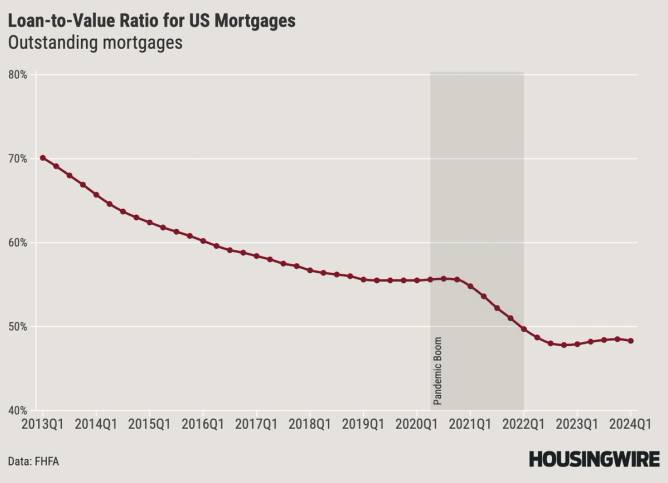
Loan-to-value ratio for US mortgages Source: Housingwire via Mike Simonsen

It's really hard to overstate how strong a financial position American homeowners are in. Currently, American mortgage holders carry only 48% loan-to-value on their homes, down from 70% a decade ago. That’s one of the central conclusions revealed by the Federal Housing Finance Agency’s (FHFA) latest update on residential mortgages. Here’s what else the agency reports:

  • Adjustable-rate mortgages (ARMs) account for 3.5% of outstanding mortgages, down from 9.6% one decade ago.
  • The average credit score among borrowers with an active loan is 743.
  • There were 50.8 million outstanding mortgages with unpaid balances totaling $11.7 trillion at the end of the first quarter of 2024.
  • Breakdown of mortgage loans by rate percentage:
    • 21.9% of mortgaged homes have a rate < 3%
    • 35.4% have a rate 3.0–3.99%
    • 18.7% have a rate 4.0–4.99%
    • 9.6% have a rate 5.0–5.99%
    • 14.3% have a rate >= 6.0%

Our take

The Great Recession that ensued after the ’08 financial crisis ended years ago. Yet, many act as if the issues we dealt with then apply even now. People still think that adjustable rate mortgages (ARMs) are a huge portion of the loan market and that there are a lot of people with subprime credit owning a lot of homes. None of those things are true. The average credit score among borrowers with an active loan is 743 and ARMs account for just 3.5% of outstanding mortgages. Homeowners, moreover, are in an unbelievably strong financial position. According to the FHFA, only 0.3% of borrowers have negative equity in their homes.

Don’t misunderstand us: There are problems with the current housing market, especially with housing affordability. But current concerns about affordability have nothing to do with the issues we faced in ’08. In fact, despite mortgage rates staying higher for longer than expected, the housing market remains supported by a solid base of exceptionally strong borrowers. The problem with the current housing market isn’t the current crop of homeowners who have homes, but the number of people who presently can’t afford one.


HOMEOWNERSHIP

10 best markets for first-time homebuyers

The California coastline july7th/Getty Images

Zillow has released its list of the best markets for first-time buyers, based on four criteria: rent affordability, the ratio of adorable for-sale inventory to renter households, the percentage of households age 29–43, and the share of available inventory on Zillow that the median household can comfortably afford. By “comfortably afford,” it means spending no more than 30% of income on the estimated monthly mortgage cost.

Here’s their list of the best markets for first-time buyers:

  1. St. Louis, MO
  2. Detroit, MI
  3. Minneapolis, MN
  4. Indianapolis, IN
  5. Austin, TX
  6. Pittsburgh, PA
  7. San Antonio, TX
  8. Birmingham, AL
  9. Kansas City, MO
  10. Baltimore, MD

Our take

With all the concern about housing affordability, it may surprise you that first-time homebuyers are a growing share of the market. Zillow found that first-time buyers accounted for half the buyers last year, while other, more conservative estimates have them making up nearly a third. We know that a lot of this comes down to location, and that’s why this list is so helpful. Though it’s not necessary, real estate investing can be more effective if you invest out of state. Often, the math works out best when you purchase homes in other markets. Use this list to help make your selection.


PROPERTY TAXES

Markets with the highest property taxes

Corporate tax 2024 Nora Carol Photography/Getty Images

ATTOM Data, a leading provider of nationwide property data, reports that property taxes on single-family homes surged by 6.9% in 2023, totaling $363.3 billion. That is nearly double the 3.6% growth rate of 2022 and represents the largest increase in the past five years. The Northeast and Midwest regions had the highest effective property rates, while the South and the West had the lowest effective property taxes.

Here are the top 10 counties with the highest effective property taxes:

  1. Summit County, OH: 3.17%
  2. Saint Lawrence County, NY: 2.59%
  3. DeKalb County, IL: 2.51%
  4. Fairfield County, OH: 2.45%
  5. Monroe County, NY: 2.34%
  6. Camden County, NJ – 2.19%
  7. Kane County, IL – 2.15%
  8. Lake County, IL – 2.15%
  9. Kankakee County, IL – 2.15%
  10. Macon County, IL – 2.13%

Our take

To maximize your returns as an investor, you have to pay attention to property taxes. Otherwise, all your gains will wither quickly. This report from ATTOM is so useful because it identifies which counties have the highest AND lowest property taxes. That’s huge. Incorporate it into your market analysis and model where you can get the best bang for your buck.

ROUNDUP

The real estate moves to keep an eye on

real estate investing news links Source: Morning Brew

TACTICS

Advice, analysis, inspiration, and strategy on how to invest in real estate

advise on real estate investing Source: Morning Brew

In addition to giving you the strategies and tactics you can use as an investor, we’ll be periodically highlighting and profiling certain investors who have been successful in real estate. We call them real estate icons. Learn and be inspired by them. Today we’ll be covering Jerry Buss.

Apartment investor

Before he became the owner of the Los Angeles Lakers, Buss made his wealth in real estate. He started out as an apartment investor. Saving money from his first job out of USC, in 1959, Buss recruited four other investors to purchase a 14-unit rental apartment in West Los Angeles for a $6,000 down payment and $100,000 loan from the bank.

Along with his business partner Frank Mariani, Jerry Buss by early 1979 amassed a real estate portfolio of three hotels, two office buildings, 1,005 single-family homes, and nearly 4,000 apartment units. Buss is reputed to have amassed a real estate empire worth about $350 million.

Buss used debt and leverage along with repeated simple strategies to amass his wealth. Some real estate investors swear by it while others (like Dave Ramsey) are philosophically opposed to using debt. We here at The Playbook don’t officially take a stance on debt, because we’ve seen investors succeed in real estate going either way.

And Jerry Buss definitely used debt to maximize his gains. He was leveraged to the hilt because he had tremendous confidence in his ability to capitalize on this belief: compared to other investment vehicles, real estate is simple. The concepts are easy to understand and implement.

Buss purchased over 1,000 homes and 4,000 apartment units. It doesn’t take a genius to do that. Once you learn the strategies and tactics of financing these purchases, your job as a real estate investor is to hone your market analysis skills to maximize your investment. Then, repeat that play over and over again. Conceptually, it’s simple. The hard part is putting in the work and discipline to do it. Hunting for the right properties that “pencil” doesn’t just happen. It takes effort.

To learn more about Buss, read Jeff Pearlman and this revealing profile of him in People.

Parting thought

“Push yourself because no one else is going to do it for you. Your future is created by what you do today. Take charge and build your own life. Be your own biggest supporter. Self-motivation is the key to success.”—Leonal Mind

That’s it for this edition. Have a wonderful weekend friends. We’ll see you back here next Thursday!


ADVERTISE // CAREERS // SHOP // FAQ

Update your email preferences or unsubscribe here.
View our privacy policy here.

Copyright © 2024 Morning Brew. All rights reserved.
22 W 19th St, 4th Floor, New York, NY 10011

Let’s Make a Game Plan

Boost your investment game with expert real estate insights. We'll keep you up to date on everything you need to know to be the smartest real estate investor you can be.

By subscribing, you accept our Terms & Privacy Policy.

A mobile phone scrolling a newsletter issue of The Playbook